I left Wall Drug unimpressed. I’d given myself a few dollars to spend if something caught my eye, but I couldn’t justify shelling out $8 for an ice cream cone. Later, I learned about the town’s history: the wife of the man who bought Wall’s only drugstore had a late-night epiphany, listening to the sounds of passing cars and brainstorming ways to boost sales in their tiny town of 300 people. She came up with the idea to advertise free ice water to tourists overheating on their way to Mount Rushmore. That was in 1931. Now, with a population of just 900, Wall Drug is reportedly handing out 20,000 cups of water daily.
Having finally seen Wall, I was glad to lay my curiosity about the place to rest. The same sign that pointed me to Wall Drug had also mentioned Badlands National Park, just seven miles away. With no real agenda, I figured I had no choice but to go. Besides, the idea of a night camping in nature sounded perfect.
Nature has always calmed me—a mother’s gentle shush rocking my restless mind. As a kid, I’d lie on the pristine grass of my dad’s sprinkler-fed yard, with Mount Rainier looming spectacularly in the distance, and lose myself in the clouds. They’d shift and morph—a dolphin turning into some funhouse version of itself before dissolving entirely. Time felt endless then, those moments immersive and all-consuming, perhaps because they were free from the constraints of growing up.
That’s what I wanted for this trip. Maybe unconsciously, I needed time to slow down. I wanted to reconnect with myself in a way that felt utterly removed from my everyday routine—free from rules, constraints, and expectations. Out here, I made the rules. I could break them if I wanted. The tone of the day, whether bad or good, was entirely my responsibility. That kind of freedom sat like a co-pilot in the passenger seat.
After a long, straight stretch of gravel road, I pulled up to a National Park outpost where a ranger in a starched uniform and dimpled hat greeted me. He told me the entrance fee was $15, a fair price for the experience of the park and a camping spot under the stars. With a sense of anticipation, I handed over the cash and drove on.
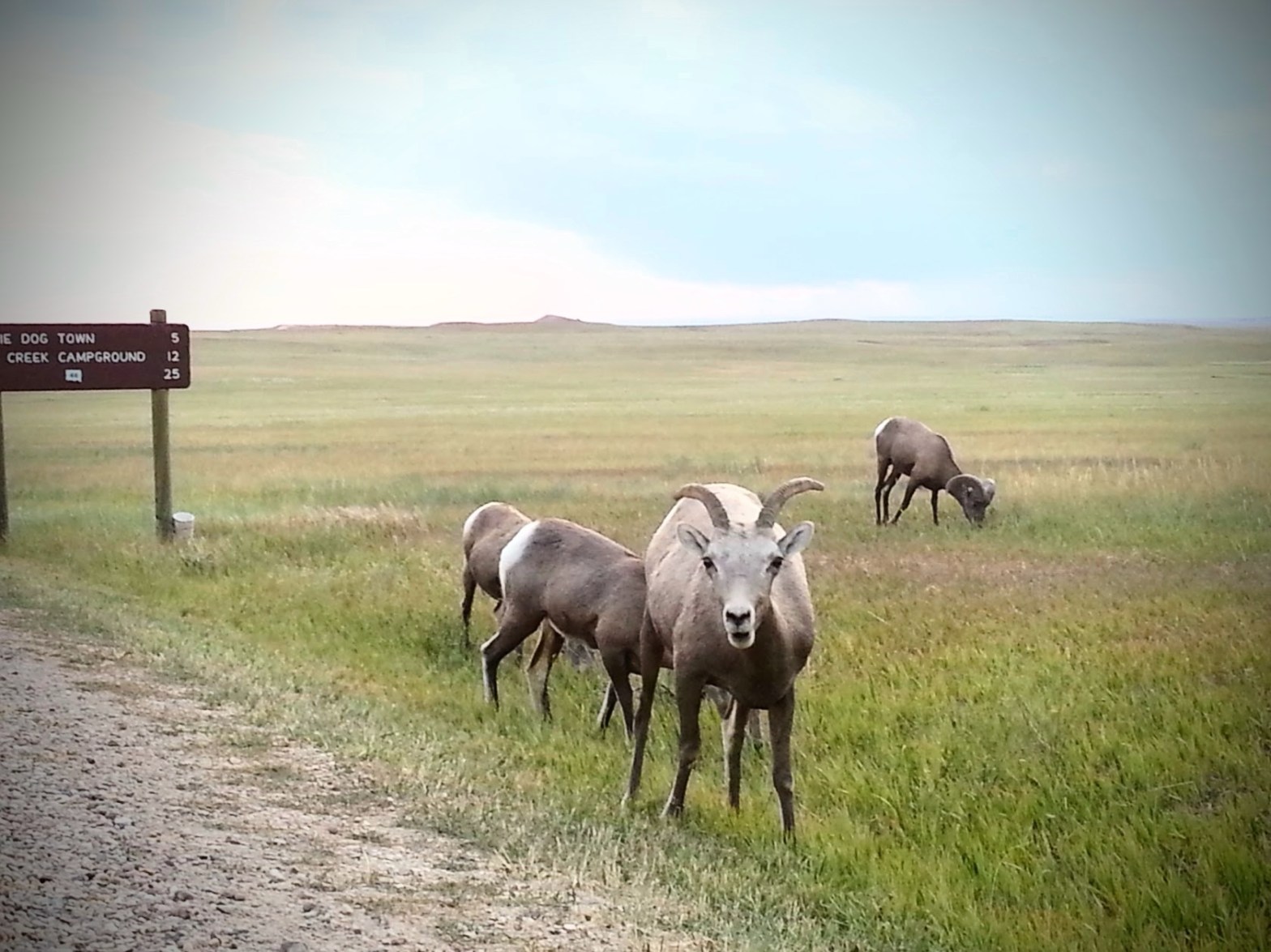
As the road curved gently, I slowed, spotting a cluster of animals ahead—sandy brown coats, off-white padded rumps, and impressive spiraled horns. I stopped the car and turned off the engine, letting the silence settle around me. It was just me and them.
One of the bighorn sheep, its jaw shifting side to side as it chewed on vegetation, locked eyes with me. Then, with deliberate steps, it started moving closer. I’d opened my car door but stayed behind it, watching with a mix of fascination and caution. Not wanting to miss the moment, I grabbed my phone and managed to snap a photo just before the sheep lost interest and turned away.
The landscape ahead stretched into a golden sea of grass, endless under the wide-open sky. Driving forward, I began to notice massive shapes in the distance. As I drew closer, more and more appeared—until, cresting a small hill, I saw an entire herd of bison sprawled across the land to my left.
I slowed to a crawl, the crunch of gravel beneath my tires the only sound breaking the stillness. Not wanting to provoke the attention of a herd of 500-pound battering rams, I stopped at a respectful distance. Whether they appreciated the space or ignored me entirely, I couldn’t tell. They continued their journey, lazily flicking their ears as if I wasn’t there. All except one calf, which paused briefly to glance in my direction. With the door ajar, I stood behind it, quietly capturing the moment on my phone.
Once they’d passed, I looked up to the sky. Gray clouds had crept in, their milky expanse hinting at rain—or worse. Not wanting to be caught unprepared, I reached for the map to reassure myself I was on track. After flipping it front to back and checking every corner, I confirmed my only camping option: Sage Creek, a dead-end road five miles ahead.
 Going On 40
One thought on “The Not-So-Bad Badlands (Book Part 27)”